

lsst.verify#
lsst.verify is a framework for packages that measure software and data quality metrics.
A metric can be any measurable scalar quantity; some examples are in the LSST Science Requirements Document (:lpm:`17`), though packages can also define ad hoc metrics.
Measurements made through lsst.verify can be uploaded to LSST’s SQUASH monitoring dashboard to help you see how code development affects performance.
Using lsst.verify#
Contributing#
lsst.verify is developed at lsst/verify.
You can find Jira issues for this module under the verify component.
Task reference#
Pipeline tasks#
Tasks#
Script reference#
Python API reference#
lsst.verify Package#
Functions#
|
Output measurements, as |
Classes#
|
Blob is a flexible container of data, as |
|
A collection of |
|
A value annotated with units, a plot label and description. |
|
Container for |
|
A measurement of a single |
|
Container for annotations (notes) associated with a single |
|
A collection of |
|
Container for verification framework job metadata. |
|
Query of |
|
Container for the definition of a metric. |
|
A collection of |
|
Semantic name of a package, |
|
Specification base class. |
Error resolving a specification document's stated inheritance. |
|
|
A collection of |
|
A threshold-type specification, associated with a |
Base error for verify. |
|
Error accessing or using requirement specifications. |
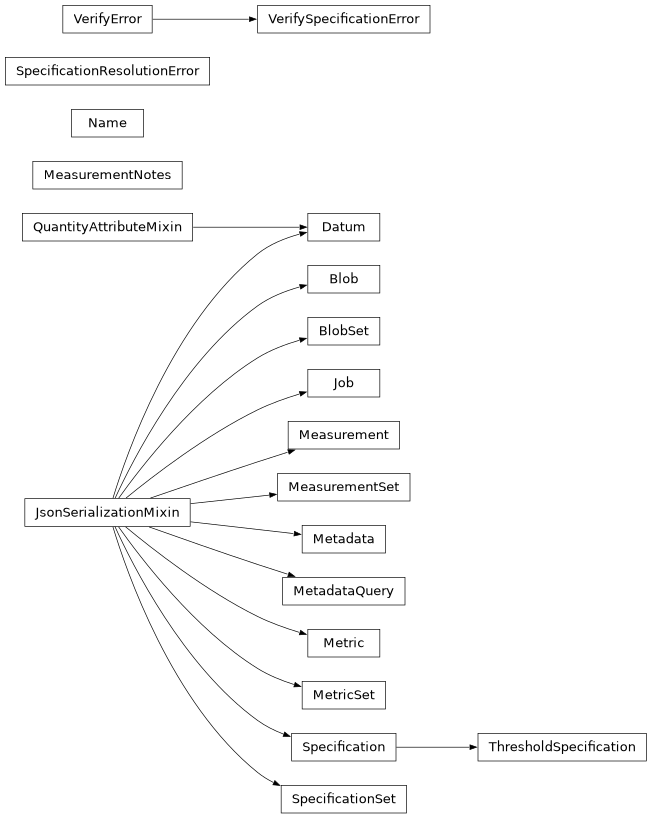
Class Inheritance Diagram#
lsst.verify.bin.dispatchverify Module#
Functions#
|
Entrypoint for the |
|
Insert metadata for lsstsw-based packages into |
|
Insert metadata for extra packages ('--package-repos') into |
|
Insert environment metadata into the Job. |
|
Ensure date_created is a valid datetime string in UTC. |
Classes#
|
Configuration for dispatch_verify.py that reconciles command line and environment variable arguments. |
Class Inheritance Diagram#
lsst.verify.extract_metricvalues Module#
Tools for loading metric values from a butler and printing them, or from two butlers and differencing them.
These functions are used by the print_metricvalues script.
Functions#
|
Load all measured non-time/non-memory metrics in the given butler repo. |
|
Load all measured timing metrics in the given butler repo. |
|
Load all measured memory usage metrics in the given butler repo. |
|
Print all metrics with measured values in the given repo. |
|
Load metric values from two repos and print their differences. |
|
Parameters butler lsst.daf.butler.Butler Butler created with the appropriate collections, etc. query str Butler dataset query to get the metric names to load. reject_suffix str or iterable, optional String or tuple of strings to not load if they appear at the end of the metric name. verbose bool, optional Print extra information when loading. |
lsst.verify.jsonmixin Module#
Classes#
Mixin that provides JSON serialization support to subclasses. |
lsst.verify.metadata.eupsmanifest Module#
Classes#
|
Iterator over packages in lsstsw's manifest.txt dataset. |
lsst.verify.metadata.jenkinsci Module#
Functions#
Gather metadata entries from LSST DM Jenkins CI environment. |
lsst.verify.metadata.lsstsw Module#
Classes#
|
lsstsw package version information based on repos.yaml and checked out Git repositories. |
lsst.verify.squash Module#
Functions#
|
GET request to the SQUASH API. |
|
POST a JSON document to SQUASH. |
|
Lookup SQUASH endpoint URL. |
Reset the cache used by |
|
Get the default HTTP client timeout setting. |
|
Get the default SQUASH API versioned used by the lsst.verify.squash client functions. |
|
|
Make the |
lsst.verify.report Module#
Classes#
|
Report tabulating specification pass/fail status for a set of |
lsst.verify.tasks Package#
Classes#
|
A base class for tasks that compute metrics from metadata values. |
|
A base class for APDB metric task configs. |
|
An abstract connections class defining a database input. |
|
A base class for tasks that compute metrics from an alert production database. |
alias of |
|
|
A Task that computes a CPU time using metadata produced by the |
alias of |
|
|
A Task that computes the maximum resident set size using metadata produced by the |
|
A base class for metadata metric task configs. |
|
A base class for tasks that compute metrics from single metadata objects. |
This class represents unresolvable errors in computing a metric. |
|
|
|
|
An abstract connections class defining a metric output. |
|
A base class for tasks that compute one metric from input datasets. |
|
An abstract connections class defining a metadata input. |
alias of |
|
|
A Task that computes a wall-clock time using metadata produced by the |
lsst.verify.timer Module#
Functions#
|
Time the enclosed block and record it as an lsst.verify measurement. |